

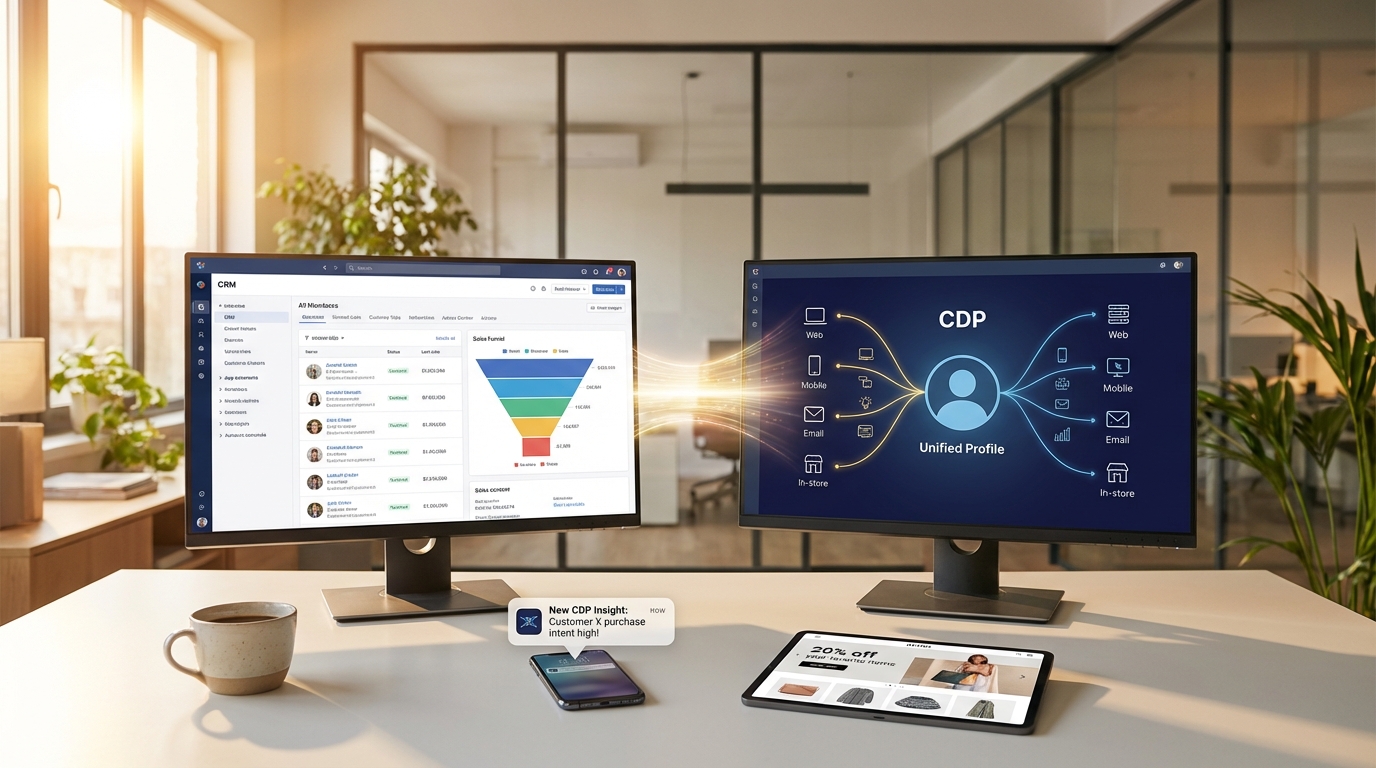
In today’s ever-changing digital landscape, the debate between CDP vs CRM is often off the mark — they aren’t rivals, but rather complementary tools that modern businesses just can’t live without. With GDPR enforcement getting more serious by the day, Google Chrome accelerating its third-party cookie purge, and customers demanding more and more from these real-time personalisation experiences, brands need both systems firing on all cylinders if they want to unlock the full value of their customer data.
What is a CRM?
Customer relationship management (CRM) systems are all about keeping tabs on people you already know — leads and accounts. They’re there to support sales, service and support teams by keeping track of the direct interactions you have with known customers.
Typical CRM data includes:
- Name, email address and phone number
- Company info and account hierarchy
- Where a sale is at and the sales pipeline
- Sales calls, meeting notes and email threads
- Support tickets and resolution history
- Contract values and renewal dates
- Customer satisfaction scores like NPS scores
CRMs started out as one-stop-shop systems for B2B sales teams to manage individual customer interactions and have since grown into big platforms that cover the whole customer lifecycle from prospect to loyal customer.
CRM Strengths
- Forecasting pipeline and sales: a clear view of where deals are and revenue projections
- Logging interactions: a complete record of sales calls, emails and meetings
- Account health report: to help you prioritise renewals and upsell opportunities
CRM Limitations
- Manual data entry: it relies on sales and support staff to put in the data
- Focusing on known customers: can’t get anything on people you don’t know yet — anonymous users fly under the radar
- Channel blindness: unable to bring together data from all different channels like web behaviour, POS, or ad platforms
CRMs are great at managing your existing customer relationships, but poor at capturing behaviours before someone becomes a customer, or across all the different digital channels they use.
What is a CDP?
A customer data platform (CDP) takes in data from all sources, stitches it all together and then activates it into a single persistent profile. Unlike CRMs, CDPs collect data from websites, mobile apps, CRM exports, point of sale systems, ad platforms, call centres and all sorts of offline files.
At its core, a CDP can:
- Resolve identities: put together anonymous and known identifiers across devices and channels
- Collect and activate data in real-time: process data as it happens, so you can respond straight away
- Manage privacy and consent: track customer preferences across every single touchpoint
CDPs are what marketing, product and analytics teams use to bring behavioural, transactional and demographic data together to power targeted campaigns, segmentation and customer journey orchestration.
Modern CDP Features
- AI-driven insights and predictive analytics (e.g. how likely a customer is to churn)
- Audience segmentation and omnichannel personalisation
- Privacy-safe collaboration like data clean rooms
Forrester reckons that the CDP market has “officially arrived” as critical enterprise infrastructure, with the market expected to grow from $5.1 billion in 2023 to $28.2 billion by 2028 [1].
CRM vs CDP: Key Differences
| Aspect | CRM | CDP |
| Primary users | Sales, service, account managers | Marketing, data analysts, growth teams |
| Data scope | Structured, manually entered data | Structured and unstructured from multiple sources |
| Time dimension | Historical logs | Real-time streaming data |
| Activation | Email campaigns, sales workflows | Omnichannel activation (email, web, mobile, paid media) |
| Data processing | Batch updates, manual entry | Continuous ingestion and unification |
| Identity resolution | Limited to known contacts | Anonymous and known profiles across devices |
| Privacy and consent | Basic | Built-in consent management for GDPR compliance |
A CDP is not here to replace a CRM — it’s here to pick up where a CRM leaves off, filling the gaps in identity resolution, cross-channel data collection and real-time personalisation that CRMs aren’t designed to deal with.
Use Cases — Each Shines in a Different Light
CRM Use Cases
- B2B SaaS sales: managing demos, deal stages and follow-ups
- Customer support: having access to ticket history and account context to speed up resolutions
- Account management: tracking renewals, upsells and customer health scores
CDP Use Cases
- Retail personalisation: bringing together web browsing, in-store sales and email engagement to deliver real-time recommendations
- Banking journey orchestration: delivering cross-channel messages based on app events and consent signals
- Travel targeting: picking up on abandoned searches and targeting users with relevant offers
Combined CRM + CDP Use Cases
- VIP experience triggers: enriching CRM data with live behavioural data and automating retention workflows
- Predictive scoring: sending churn and upsell likelihood scores from the CDP to the CRM to help sales prioritise their efforts
- Marketing attribution: using CDP segments to power paid media campaigns and feeding results back into the CRM
How CDPs and CRMs Work Together — Getting the Most out of Your Customer Data
The Customer Data Platform (CDP) acts as a kind of ‘nerve centre’ for your customer data, collecting all the relevant info from websites, apps, CRM exports, POS systems, call centres, and offline sources. It then uses identity resolution to bring together all those disparate identifiers into one coherent customer profile. The CDP then passes that enriched data on to your CRM, email platforms, ad tools and personalisation engines.
The truth is, today’s marketers are already looking for ways to get their data together — a recent Salesforce survey found that 84% of marketers say that getting hold of good customer insight, using first-party data and being able to track transactions is their top priority, yet only a quarter of them feel like they’re actually using that data to deliver real personalisation [2]. There’s a gap between wanting good customer data and knowing how to use it to drive real moments of personalisation — which is where a CDP makes all the difference.
When you get CDP and CRM working well together, they give you:
- Identity resolution across all the different places your customers interact with you
- Real-time audience activation, so you can reach out to your most valuable customers
- A privacy-first architecture that’s designed to keep your customers safe, under GDPR and in a cookieless future
Customer Insight in the Real World
“We can use the CDP and universal identifier from Zeotap to open up a whole new CRM strategy with our partners. We can combine email addresses or phone numbers with data from our video, display and audio channels. This CDP is game-changing for us.” — Felipe Moreno Padilla, Head of Data Advertising Strategy, Unidad Editorial [3]
This integration lets you create seamless customer journeys that span from the point when a customer is just browsing to when they log in, use your app, or get in touch with your support team — all of which are then visible in your CRM, enriched with data from the CDP.
Security, Privacy and the Cookieless Future
Regulations around data and cookies have completely upended the rules of the game when it comes to digital marketing. According to a recent report from IAB Europe, programmatic advertising in Europe grew by 18.4% last year — a big comeback, driven by renewed investment in data-driven buying and first-party data strategies [4]. This change isn’t just a blip — 65% of marketers globally are planning to increase their focus on first-party data specifically because they know it will help them stay ahead of the impact of third-party cookies, and 73% now see it as essential for keeping up with rising privacy risks [5].
Why CDPs Matter More Than Ever
As things get tougher with regard to data privacy, CDPs are the solution because they address three key challenges that CRMs just can’t compete with:
- Centralised consent management — making sure that every communication respects individual preferences
- Privacy built into the architecture from the ground up — so you’re not stuck with bolted-on solutions
- Cookieless identity solutions that keep you addressable using first-party and deterministic identifiers
It’s not just about compliance — the commercial case is just as strong. BCG’s Personalisation Index found that leaders in personalisation grow revenue 10 percentage points faster than their competitors, and that brands with a unified first-party view of their customers can get double the return on ad spend from a single placement compared to those who are struggling to get their data together [6].
When to Use CRM, CDP or Both
When a CRM is enough
- You’re a small B2B business with low customer interaction volumes
- You’re a pipeline-focused business with limited digital touchpoints
When you need both
- You’ve got customer data spread across different systems
- You’ve got siloed teams that need a unified view of the customer
- You need to deliver real-time personalisation
- You’re getting ready for a world without cookies
Getting Started: Integrating CDP with CRM
Set some goals: Want to cut acquisition costs? Need to boost personalised customer experiences?
Audit your data sources: Where’s your CRM data coming from? What’s in your web analytics? POS? Call centres? Marketing tools?
Get CRM on board: Start with a baseline unified profile in the CDP
Add in some behavioural data: Get web and mobile events into the mix, and enrich those profiles with identity resolution
Run some pilot use cases: Test how an abandoned cart journey works in the real world, or see how a win-back campaign can bring back lapsed customers
Expand your orchestration: Take those predictive audiences and use them to drive personalisation across multiple channels
Governance: Keep an eye on data quality, consent compliance and security posture
CDP vs CRM FAQs
The real question here isn’t whether you should go with a CDP or a CRM — it’s how you actually make your organisation’s customer data work for you across all touchpoints, while making sure you comply with tighter regulations and declining cookie usage.
For most bigger brands out there, the answer is probably a combination of the two tools working together — the CRM to handle customer relationships and workflows, and the CDP to build that unified base of customer data which is both privacy-compliant and first-party — the kind of thing that’s going to underpin everything else.
Want to see just how your CRM data can power a truly unified customer view that doesn’t rely on cookies? Contact Zeotap to arrange a demo and see for yourself what’s possible when you bring your customer data platform and CRM into the same room.
Sources
[1] Forrester Wave: Customer Data Platforms for B2C, Q3 2024
[2] Salesforce State of Marketing, 9th edition
[3] Unidad Editorial case study, zeotap.com
[4] IAB Europe AdEx Benchmark Report 2024
[5] Deloitte first-party data research
[6] BCG Personalisation Index 2024