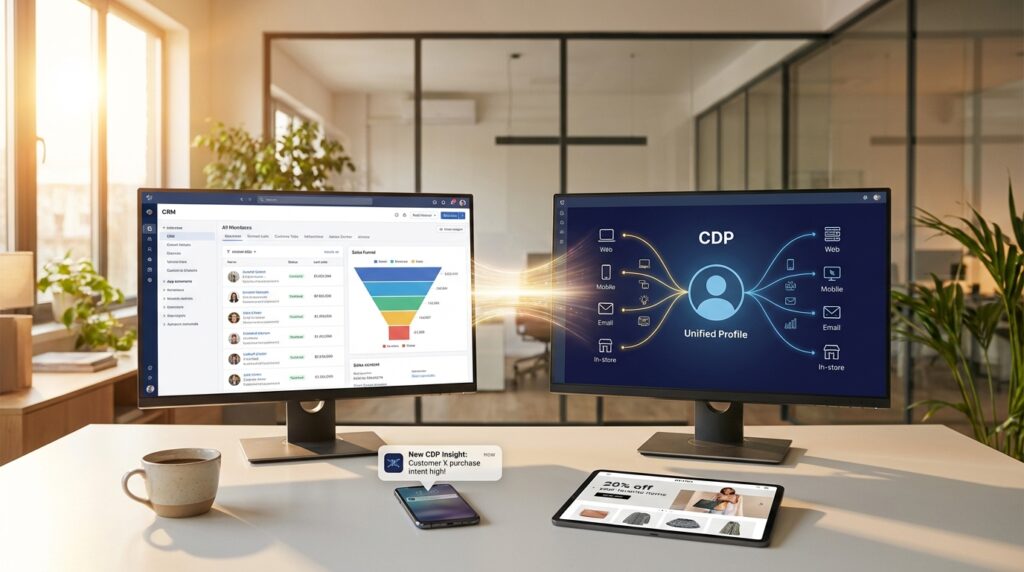


A customer data platform (CDP) is a powerful piece of software designed to collect, sort and then activate customer data from every single point of contact into one single, up-to-date customer profile. It does this by serving as a centralised hub for all customer data, making it easily accessible to teams all across the business. Think of it as a significant step forward compared to older data management tools that used to keep information locked away in separate departments — a CDP lets every team, from marketing to analytics to service, get a real-time, single view of every customer across every channel.
The global CDP market is growing fast, valued at $3.28 billion in 2025 and projected to hit $5.7 billion by 2026 (Fortune Business Insights, 2025). This rapid growth reflects a fundamental shift in how businesses deal with customer data — away from storing it in separate channels towards a unified approach built for activation.
So what does a Customer Data Platform actually do?
A CDP performs four main jobs, each one building on the last: data ingestion, identity resolution, segmentation and activation. These four functions fall under the main tasks that customer data platforms perform — collecting data, making sense of it, using it to send targeted messages and pulling insights from it.
1. Data Ingestion
A CDP brings in data from anywhere in your tech stack — websites, mobile apps, CRM systems, call centres, email platforms and offline databases — regardless of format or frequency. This is usually done in one of three ways: real-time event streaming (tracking user actions as they happen), scheduled batch imports (loading in historical data) and API connections (getting or sending data from and to third-party platforms). By doing this, a CDP creates a single, unified customer profile by consolidating information from across the organisation — a constantly updated, all-encompassing data feed that no single point solution can replicate.
2. Identity Resolution
What sets a CDP apart from a data warehouse or a simple integration layer is its ability to perform identity resolution. Most organisations hold fragmented identifiers for the same person — a cookie from a desktop session, an email address from a CRM record, a loyalty number from a POS system. A CDP stitches these together into one unique customer profile using one of two methods:
- Deterministic matching — links records using exact, verified identifiers like email addresses and phone numbers. High accuracy but lower reach.
- Probabilistic matching — uses statistical signals like shared IP addresses, device fingerprints or behaviour patterns to infer whether records belong to the same person. Higher reach but lower accuracy.
Most enterprise CDPs use a combination of both in a hybrid model — deterministic matching as the primary anchor, with probabilistic inference to catch records where verified identifiers aren’t available.
3. Audience Segmentation
Once unified profiles are in place, a CDP lets marketing and analytics teams build precise audience segments using any combination of behavioural, demographic, transactional and predictive attributes — without needing to write SQL. Rules-based segmentation lets users define audiences based on specific criteria (for instance, customers who purchased in the last 30 days but haven’t opened an email), while AI-assisted segmentation goes further by identifying non-obvious patterns like early-stage churn signals or upgrade likelihood — running predictive models across the unified profile dataset.
4. Downstream Activation
Data that sits in a platform without being used is essentially useless. A CDP’s final job is activation — sending segments and profile attributes downstream to every other system in the stack (ad platforms, email service providers, personalisation engines, customer service tools and analytics suites) in real time. This is what enables omnichannel orchestration — a single customer action can update a profile, trigger an email, suppress an ad and flag the customer for proactive contact, all simultaneously.
Customer Data Platform vs CRM vs DMP: What is the Difference?
These three terms get used interchangeably, but they serve fundamentally different purposes.
A CRM (Customer Relationship Management system) stores structured records of known contacts entered manually. It’s well-suited to managing one-to-one relationships and tracking sales pipeline activity — but it cannot capture anonymous behaviour or resolve cross-device identity. It isn’t designed for marketing activation at scale.
A DMP (Data Management Platform) aggregates anonymous, cookie-based audience data for ad buying — usually from third-party data brokers. Profiles are anonymous, short-lived (around 90 days) and built on probabilistic identifiers that are increasingly restricted under EU privacy law. As third-party cookies are phased out, the DMP model is structurally weakening.
A Customer Data Platform — Where DMP and CRM Finally Get Along
A CDP is where the DMP’s reach and the CRM’s reliability finally meet. It captures both known and anonymous data, resolves it into permanent first-party profiles, and makes those profiles accessible to every marketing, service and analytics system across the full customer journey. A CRM requires a human to manually log an interaction; a DMP discards profiles after 90 days. A CDP picks up every digital and offline signal and retains it for as long as needed.
For EU businesses, this distinction has serious compliance implications. DMPs rely on third-party data that is increasingly restricted under GDPR and the ePrivacy Directive. A CDP built on consented first-party data is not just compliant — it is structurally resilient to the regulatory changes dismantling third-party data infrastructure across the EU.
Why Third-Party Cookie Deprecation Makes CDPs a Necessity
Digital marketing has long relied on third-party cookies to track users across websites, build profiles and target ads — but that infrastructure is breaking down. Research estimates that by 2025, cookie deprecation could reduce the prevalence of cookies on websites by up to 80% (Dynata, 2024). For advertisers and publishers, this represents an addressability crisis — audiences that were previously reachable via third-party identifiers are becoming invisible.
CDPs are the direct response to this problem. By building audience profiles from first-party data — customer interactions, app activity, loyalty programmes, purchase history — a CDP creates an addressable audience base that doesn’t depend on third-party identifiers. Customer profiles can then be matched with publisher and platform data in clean rooms using privacy-preserving technologies, enabling precise audience targeting without the risks of cookie-based tracking.
This shift also changes how personalisation works in practice. Rather than inferring intent from anonymous behavioural signals scattered across the web, a CDP-powered personalisation strategy uses actual first-party signals — purchase history, product preferences, support requests, loyalty status — that are more accurate and more reliable than cookie-derived inference.
How a CDP Handles Privacy and Consent
Compliance with EU data protection law isn’t something you can bolt on to a CDP — it has to be built into the platform from the ground up. With cumulative GDPR fines now exceeding €5 billion by 2025 (DLA Piper, 2025), getting this wrong is not an option. A CDP operating in the EU needs to address three areas.
Consent Management Integration
A CDP integrates with consent management platforms to capture and respect user consent at the point of data collection. If a customer opts out of personalised advertising, their profile is automatically excluded from those activations in real time — no manual intervention required. Consent preferences are stored as part of the profile and flow through to every connected system.
Data Governance and Access Policies
Enterprise CDPs enforce access controls that determine which teams can view, export or act on specific data — particularly important in regulated sectors like finance, healthcare and telecoms, where different teams operate under different legal bases for data processing. Built-in governance rules prevent data from being used for purposes beyond its original collection.
Data Storage and Portability
EU organisations increasingly require customer data to be stored and processed within the EEA. Enterprise-grade CDPs need to support configurable data residency, alongside data portability and deletion rights under GDPR.
How to Pick the Right Customer Data Platform for Your Business
With CDP adoption accelerating — 50% of the Global 2000 are expected to have deployed one in the near future (IDC, 2024) — choosing the right platform is critical. There are five key areas to evaluate.
- Integration depth. A CDP is only as useful as the data it connects with and the systems it activates. Check the native connector library against your existing tech stack — ad platforms, email providers, CRM systems, analytics tools, data warehouses — and assess how much custom engineering each integration requires.
- Identity resolution quality. Ask vendors to demonstrate match rates — both deterministic and probabilistic — against your own data. Generic benchmark performance doesn’t tell you how the platform will perform on your actual audience profile.
- Privacy architecture. For EU deployments, ensure the platform has native GDPR-compliant consent management, configurable data residency within the EEA, and documented data processing agreements. Privacy capabilities should be built into the platform, not added as an afterthought.
- Return on investment. Evaluate the revenue potential from targeted campaigns and the cost of customer acquisition across sources. Set clear KPIs before deployment so you can measure impact accurately.
- AI capabilities and deployment flexibility. Modern CDPs come equipped with AI, though some require months of model training before delivering value. Also consider deployment options — whether the platform fits your existing cloud infrastructure or requires significant rearchitecting.
Customer Data Platform Use Cases
CDPs are used across a wide range of functions, depending on the business and its goals.
Acquisition and Growth
Marketing teams use unified customer profiles to build high-fidelity lookalike audiences — targeting people who behave like their best customers. The richer and more accurate the underlying data, the better the lookalike model performs.
Case study: German department store Breuninger used this approach to retarget high-value customers across Google, Meta and Adform — achieving a 46% increase in average basket value and a 30% improvement in sales before returns (Breuninger case study, Zeotap, 2024).
Retention and Churn Prevention
A CDP enables real-time detection of churn signals — tracking behavioural indicators like declining engagement and falling purchase volume, then comparing them against historical churn patterns. When a profile matches churn criteria, targeted re-engagement can be triggered automatically.
Case study: A mobile bank in Europe used CDP-derived audience insights to identify churn signals and extend lookalike models for re-engagement — reducing customer acquisition costs while improving retention across European markets (Zeotap, 2024).
Omnichannel Journey Orchestration
A CDP acts as the central orchestration layer, ensuring that every channel — email, push notifications, personalisation engines — is working from the same real-time customer profile. A customer who completes a purchase on mobile will no longer receive an abandoned basket email, because both systems draw from the same unified profile.
Data Governance in Regulated Industries
For financial services, healthcare and telecoms, a CDP serves a significant compliance function alongside its marketing role — providing a secure environment for collecting, storing and sharing customer data between business units, with audit trails and consent records available for regulatory reporting.
Frequently Asked Questions
What is a customer data platform?
A CDP collects data from every customer touchpoint, resolves fragmented records into a single unified profile, builds audience segments from that data and activates those segments across downstream marketing, analytics and service systems in real time.
What’s the difference between a CDP and a CRM?
A CRM manages known-contact records entered manually by sales and service teams, optimised for tracking relationships and pipeline activity. A CDP captures all customer data — including anonymous behaviour and cross-device interactions — automatically, resolves it into unified profiles and makes those profiles available for marketing activation at scale. They are complementary: a CDP typically provides the data foundation that enriches CRM records.
Is a customer data platform the same as a data warehouse?
No. A data warehouse is a storage and analytics layer for querying historical data — it requires technical expertise and isn’t designed for real-time activation. A CDP is an operational layer that unifies data, builds profiles and activates audiences in real time. Some modern architectures use a data warehouse as the underlying storage layer for a CDP (the composable CDP model) — but the activation and orchestration capabilities remain distinct.
What does customer data management mean?
Customer data management is the process of collecting, organising and governing customer information across an organisation. A CDP is often the primary technology used to implement customer data management — providing the infrastructure for data unification, quality control, consent management and cross-channel activation.
Which customer data platform is the best?
It depends on your requirements. The right CDP for a given organisation will depend on its existing tech stack, scale, industry, geographic footprint and privacy requirements. For European enterprises, this also means considering GDPR-native architecture, data residency and documented compliance with EU regulation. Always run a proof-of-concept with your own data before committing — vendor benchmarks are not a substitute for testing against your actual audience profile.