
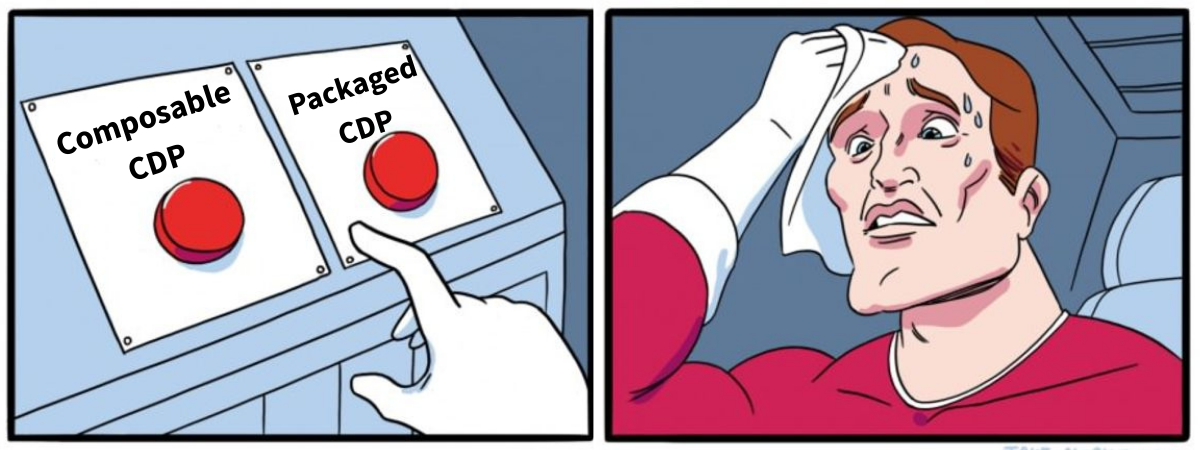
The CDP market is splitting into two camps: Packaged and Composable CDPs. Most vendors force organisations to choose between the two.
If you are currently evaluating your CDP options, you’ve likely been bombarded with mixed marketing messaging and conflicting advice. Given all the buzz around, it can be hard to get a clear understanding of which deployment would actually make the most sense.
This is why we put together this quick guide: to help you understand the benefits and drawbacks of each deployment and make the best choice for your organisation (don’t miss the 30-second self-assessment guide at the end of this blog!).
At Zeotap, we’ve seen this choice from both sides. As our platform is built to support both architectures from day one, we don’t have a horse in the either/or race. Our goal isn’t to pull you toward a specific camp, but to give you the framework to decide which one actually fits your needs.
Navigating the Shift in the Market
The debate between Packaged and Composable hasn’t emerged in a vacuum. It’s a logical response to several meaningful forces that are shaping the market:
- The Gravity of the Data Warehouse: With platforms like Snowflake, BigQuery, and Databricks serving as the “single source of truth,” many teams prefer to activate customer data where it lives, rather than duplicating it into external tools.
- The Real-Time Marketing Mandate: Modern marketing demands sub-second latency for in-the-moment personalisation, a requirement that often clashes with the batch-processing nature of a warehouse-only architecture.
- Engineering Autonomy and Control: Teams are demanding more direct control over their data, seeking solutions that integrate within their existing infrastructure and processes while supporting established internal governance standards.
The Core Decision Framework
To understand which path best fits your organisation, you must evaluate how a CDP will sit within your broader technical ecosystem.
1. Data Gravity: What is your ‘Source of Truth’?
- Packaged: You move your data into a high-performance marketing ecosystem, optimised for scale and speed of customer engagement. This decouples marketing’s operational needs from your core systems, ensuring engagement doesn’t have to wait for warehouse processing cycles.
- Composable: Your Cloud Data Warehouse remains the undisputed centre. The CDP capabilities are brought directly to your existing infrastructure, ensuring every interaction is fueled by the same governed data powering the rest of the enterprise.
2. Identity Resolution
- Packaged: You lean on the vendor’s core ID resolution capability, as the platform stitches together fragmented signals into a unified profile. This is the ideal choice for teams that want a sophisticated, high-performance, ready-to-go ID stitching without maintaining the underlying stitching themselves.
- Composable: Many organisations choose to build and manage their internal ID stitching logic directly within their warehouse.
However, at Zeotap, we offer a third path: providing a fully Composable deployment that leverages our specialised ID stitching. This allows you to maintain a ‘warehouse-first’ architecture while still benefiting from our core platform capabilities without having to build the identity logic from scratch.
3. Resource Allocation and Team Structure
- Packaged: You invest in platform-led efficiency. By choosing a managed environment, you reduce the ‘people cost’ of maintaining data pipelines and identity logic, as the CDP vendor handles the operational upkeep of the marketing data layer.
- Composable: You invest in infrastructure-led control. This model relies on your internal engineering team to build and maintain the ‘pipes’ that connect your warehouse to your activation channels. While this requires a higher allocation of internal technical resources, it ensures your data team maintains total oversight and control.
4. Total Cost of Ownership
- Packaged: Your costs are predictable and consolidated within the platform subscription. Because the vendor manages the infrastructure, compute, and maintenance, you have a clear line of sight on your annual budget. This model typically trades a higher upfront licensing fee for a significantly lower internal “tax” on your data and engineering teams.
- Composable: Your costs are distributed and variable. While the software licensing fees are relatively lower, you must account for the increased “hidden” costs: the internal people hours of the engineers required to build and maintain the pipelines, and the variable compute costs billed by your Data Warehouse.
5. Governance and Privacy
- Packaged: The CDP provides a managed environment specifically engineered to handle customer data with built-in privacy tools, consent management, and access controls. At Zeotap, this is backed by the strict enterprise-grade certifications, including GDPR, SOC 2, ISO 27001, ISO 27701, and CSA STAR Level Two.
- Composable: You rely on centralised warehouse security, inheriting the security protocols, encryption, and residency rules you have already established in your Data Warehouse. However, the CDP still manages the compliance layer for activation, ensuring that GDPR-mandated consent checks are applied to your warehouse data before it is synced to any downstream marketing channels.
6. The Activation Loop
- Packaged: The CDP can react to customer behaviour in milliseconds. This is due to the fact that the data is already residing and processed within the CDP. This is the best fit for ‘in-the-moment’ use cases, such as real-time onsite personalisation or immediate abandoned-cart triggers that require ultra-low latency.
- Composable: Traditionally, activation in this model is tied to your warehouse’s processing schedule, which can introduce latency. To achieve real-time response, many composable setups require complex additional engineering or ‘reverse ETL’ pipelines to bypass standard batch cycles.
However, at Zeotap, we have bridged this gap. Our architecture allows for real real-time triggers in both deployments: end-to-end subsecond activation, ensuring that even in a ‘warehouse-first’ setup, you aren’t forced to sacrifice the speed of customer engagement
The 30-Second Self-Assessment
If you are still on the fence, use this quick-fire audit. See which points most closely align with your current organisation’s reality and your team’s 12-month roadmap.
| You are likely a candidate for a Packaged CDP if: | You are likely a candidate for a Composable CDP if: |
| Speed to Value You need a high-performance environment that can be stood up and operational independently of your warehouse’s internal backlog. Managed Operations Your team prefers a turnkey environment where the platform automatically handles the technical “plumbing” of your customer data, from ingestion to activation. Technical Decoupling You want to ensure marketing’s high-frequency data needs (e.g. real-time personalisation or large-scale audience syncing) don’t compete for the same compute resources as your core business intelligence and reporting. Predictable TCO You prefer a consolidated, subscription-based cost model that reduces the “hidden” internal tax on your engineering and data teams. | Warehouse-First Mandate Your IT or Data leadership has dictated that the cloud data warehouse must remain the sole, immutable engine for all customer data. Engineering Depth You have an available, high-calibre data engineering team that prefers to maintain control over the “pipes” and logic within your own cloud infrastructure. Infrastructure Integration Your team prefers to maintain the entire data workflow, including logic, modelling, and activation, directly within your own cloud environment for total architectural consistency. Zero-Copy Security Your internal policies require that sensitive customer data never leave your internal environment, making native warehouse activation a non-negotiable requirement. |
Note: For organisations with strict “Zero-Copy” or data residency mandates who still want the speed and ease of use of a managed platform, Zeotap also offers a Packaged Client-Hosted deployment. This allows you to run our full end-to-end CDP within your own GCP environment, ensuring data never leaves your perimeter.
Conclusion: Selecting the Right Fit
Ultimately, the choice between Packaged and Composable is about understanding your priorities, your team’s capabilities, and your long-term technical goals.
Whether you require the turnkey efficiency of a managed solution or the architectural control of a warehouse-first deployment, the goal remains the same: ensuring your customer data is actionable, governed, and scalable.
At Zeotap, we built InfraFlex to support this choice. By offering the industry’s most flexible deployment model, spanning pure Composable, Packaged, Client-Hosted, and everything in between, we ensure your technology stack aligns with your organisational reality. The best architecture is simply the one that suits you best today, while remaining flexible enough to support where you are going tomorrow.
If you’d like to chat with one of our experts to understand the best deployment path for your organisation, click below.